Global edge caching network
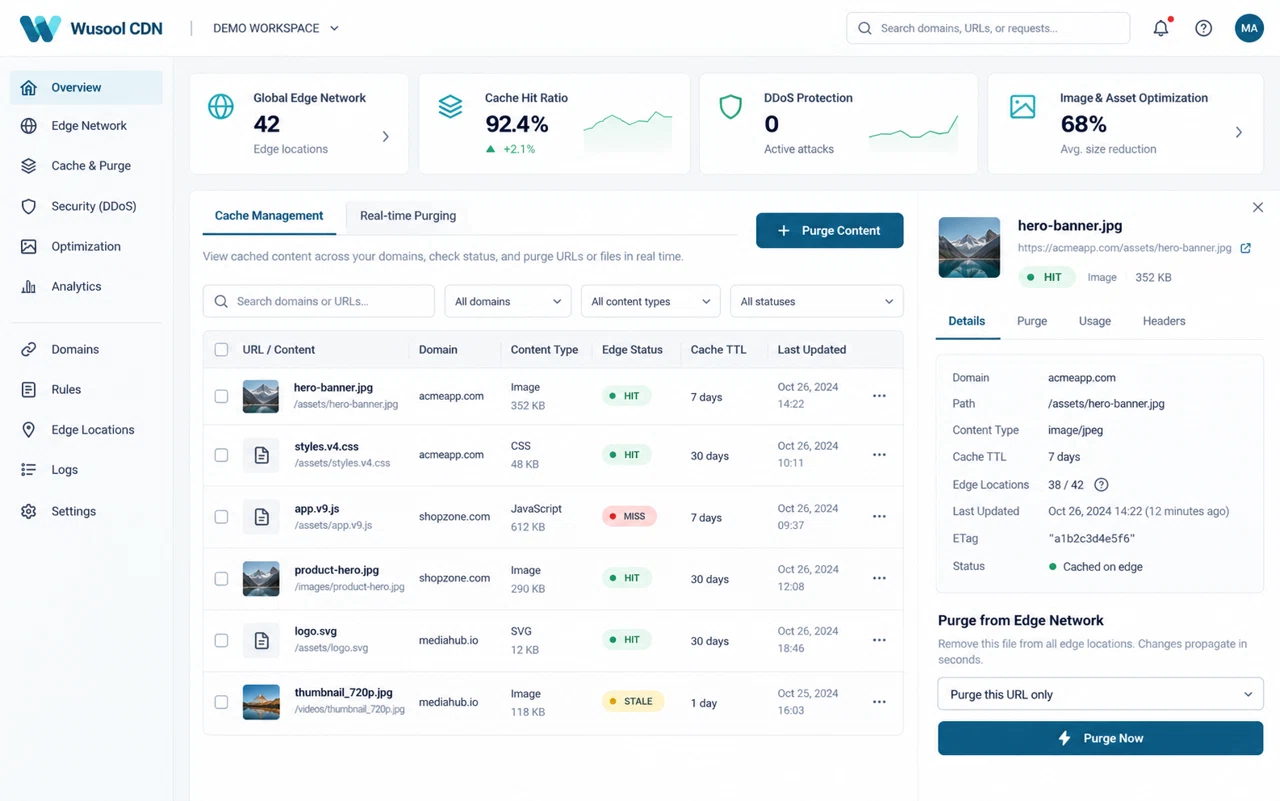
Serve cacheable assets from configured edge locations to reduce repeated requests to the origin.


Deliver public content with a clear update path.
Wusool CDN starts with the locations your audience uses and the files they need. Caching can improve delivery, but an updated asset also needs a predictable route to users. Review expiry and invalidation rules, the origin system and the separation between public files and private content.
Content delivery should improve the visitor experience without serving stale or private material incorrectly.

Explore how the product could bring its tools and working records into one view. Review the workflow design during your product walkthrough.
Connect each capability to a day-to-day task and a practical result your team can evaluate.
Serve cacheable assets from configured edge locations to reduce repeated requests to the origin.
Invalidate changed assets deliberately so customers receive the intended version after an update.
Review traffic controls and DDoS settings alongside the agreed protection scope.
Bring one example from your daily work. We can review the records involved, who owns each step and which integrations are needed before defining the implementation scope.
Discuss your workflowWe discuss the content types, cache rules and origin behaviour before configuration. Purging and version changes need a clear operating path.
Compare a page from the locations your audience uses, then update an asset and inspect when the change appears. Agree caching and invalidation rules. Review private content separately from files that can be distributed publicly.
An illustrative scenario to discuss when planning your project.The people involved include web operations teams, application owners and infrastructure staff. Begin with a small, representative set of origin hosts, cache rules, asset paths and invalidation requirements, then identify the decision or action each role needs to complete. This helps shape a useful first release and avoids collecting information that nobody uses.
A working setup needs more than a successful first deployment. Agree access, environment boundaries, monitoring, recovery and change ownership. Review a normal operation and an interrupted one before handover, with clear instructions for diagnosing the issue and deciding whether to retry, restore or roll back.
Identify the current sources of origin hosts, cache rules, asset paths and invalidation requirements. Check data quality, shared references and required fields before agreeing what will be migrated, connected or recreated.
Review the needs of web operations teams, application owners and infrastructure staff. Document permissions, required integrations, the authoritative system for each record and what happens when information cannot be exchanged.
Use safe sample data to publish an updated asset and confirm that cache invalidation delivers the expected version. Agree expected results, review exceptions and record acceptance decisions before widening access.
Name the configuration owner, change decision-maker and support contact. Plan training and documentation around ordinary tasks, then review early use under the agreed support arrangement.
Prepare examples of origin hosts, cache rules, asset paths and invalidation requirements, with confidential details removed. Explain the step that takes the most effort or causes confusion, and identify who needs to review the result.
We define a scenario that lets your team publish an updated asset and confirm that cache invalidation delivers the expected version. Compare the result with the current process and document requirements and gaps before approving the implementation scope.
The required systems and data sources are reviewed first. The integration plan covers access, field mapping, transfer timing and responsibility for errors. The proposal identifies included connections and any custom work needed.
The proposal considers features, users or workload, the operating environment, integrations and migration. Training, operational ownership and the support arrangement are agreed alongside the implementation scope.