General ledger & chart of accounts
A structured ledger gives finance one place to trace balances back to their underlying entries.


Know where the numbers come from.
Mizan Accounting brings the story behind a balance into focus. Invoices, payments and ledger records should connect clearly enough for your finance team to explain what changed and why. Start with the transactions you handle every week, then shape the approvals, reconciliations and reporting around those records.
When finance staff spend month-end reconciling different spreadsheets, the first need is a reliable record of transactions.

Explore how the product could bring its tools and working records into one view. Review the workflow design during your product walkthrough.
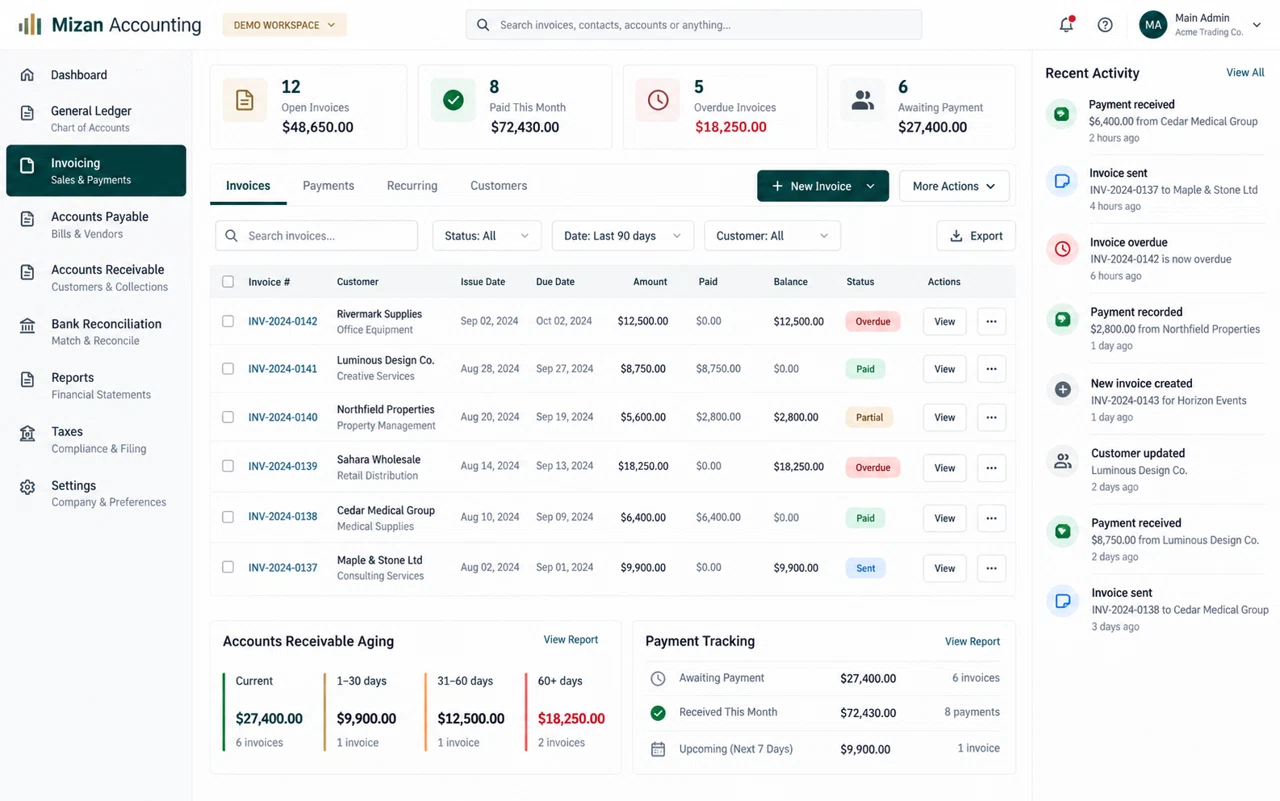
Connect each capability to a day-to-day task and a practical result your team can evaluate.
A structured ledger gives finance one place to trace balances back to their underlying entries.
Connect invoices to payments so staff can distinguish settled bills from amounts still due.
Track supplier and customer balances together to plan collections and upcoming payments.
Bring one example from your daily work. We can review the records involved, who owns each step and which integrations are needed before defining the implementation scope.
Discuss your workflowAn accounting workspace can bring invoices, payments and ledger entries together, with review controls and reports that trace back to the source.
Enter a supplier invoice, record a partial payment and compare the remaining amount with the ledger. Review how corrections are approved and traced. The important test is whether the finance team can explain the balance from the underlying transactions.
An illustrative scenario to discuss when planning your project.The people involved include accountants, payment approvers and finance managers. Begin with a small, representative set of opening balances, invoices, payments and ledger accounts, then identify the decision or action each role needs to complete. This helps shape a useful first release and avoids collecting information that nobody uses.
A useful financial view explains where a figure came from and which period it belongs to. Agree who may create, review and correct records, then test the reports against representative source transactions. Exceptions need a documented review route before the workflow becomes part of everyday operations.
Identify the current sources of opening balances, invoices, payments and ledger accounts. Check data quality, shared references and required fields before agreeing what will be migrated, connected or recreated.
Review the needs of accountants, payment approvers and finance managers. Document permissions, required integrations, the authoritative system for each record and what happens when information cannot be exchanged.
Use safe sample data to reconcile an invoice, partial payment and outstanding balance to the ledger. Agree expected results, review exceptions and record acceptance decisions before widening access.
Name the configuration owner, change decision-maker and support contact. Plan training and documentation around ordinary tasks, then review early use under the agreed support arrangement.
Prepare examples of opening balances, invoices, payments and ledger accounts, with confidential details removed. Explain the step that takes the most effort or causes confusion, and identify who needs to review the result.
We define a scenario that lets your team reconcile an invoice, partial payment and outstanding balance to the ledger. Compare the result with the current process and document requirements and gaps before approving the implementation scope.
The required systems and data sources are reviewed first. The integration plan covers access, field mapping, transfer timing and responsibility for errors. The proposal identifies included connections and any custom work needed.
The proposal considers features, users or workload, the operating environment, integrations and migration. Training, operational ownership and the support arrangement are agreed alongside the implementation scope.